

Monjayaki vs Okonomiyaki: A Battle of the Japanese Savory Pancakes
Monjayaki and Okonomiyaki are two of Japan’s most delicious savory pancakes. They are both cooked on an iron griddle, but they have different ingredients, batter, cooking methods, eating styles, and tastes. In this article, we will join the match of Monjayaki vs Okonomiyaki that helps you decide which one is the perfect Japanese savory pancake for you.
Monjayaki vs Okonomiyaki at a Glance
Before getting into the details, here is a quick look at the main differences between Monjayaki vs. Okonomiyaki:
| Feature | Monjayaki | Okonomiyaki |
|---|---|---|
| Origin | Tokyo, especially Tsukishima | Osaka and Hiroshima |
| Batter | Thin and dashi-rich | Thicker and pancake-like |
| Texture | Soft, gooey, and slightly crispy | Fluffy, firm, and crispy outside |
| Cooking style | Ingredients are grilled first, then mixed with the batter | Ingredients and batter are shaped into a pancake, or layered in Hiroshima style |
| How to eat it | Directly from the griddle with a small spatula | Cut into pieces and eaten with a spatula |
| Flavor | Savory and often more strongly seasoned | Savory, sweet, tangy, and umami-rich |
| Best known for | Tokyo food culture | Osaka and Hiroshima food culture |
Both dishes are customizable, interactive, and delicious, but the experience is quite different. Monjayaki is the more unusual choice, especially for first-time visitors, while Okonomiyaki is generally easier to recognize as a Japanese savory pancake.
Let This Story Take You to the Match of Monjayaki vs Okonomiyaki
First, We Have Okonomiyaki
Imagine you are in Japan, walking along a busy street full of restaurants and food stalls. You smell something delicious, something that makes your mouth water and your stomach growl. You follow your nose and find yourself in front of a large iron griddle, where a chef is cooking something that looks like a pancake. But wait, is it really a pancake? It seems to have cabbage, meat, seafood, and other ingredients mixed in the batter. And what is that sauce on top? Is it mayonnaise? And what are those flakes that are moving like they are alive?
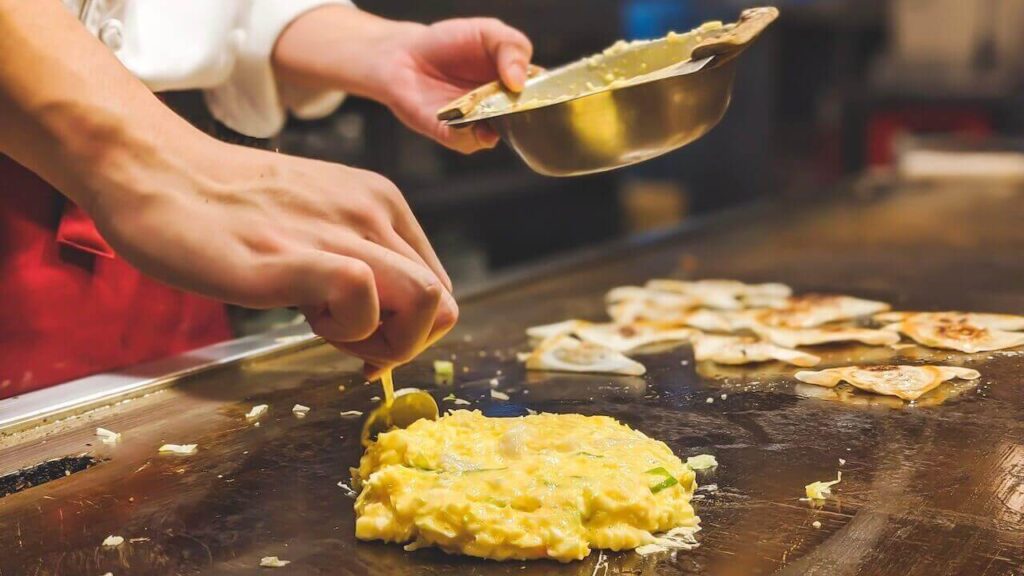
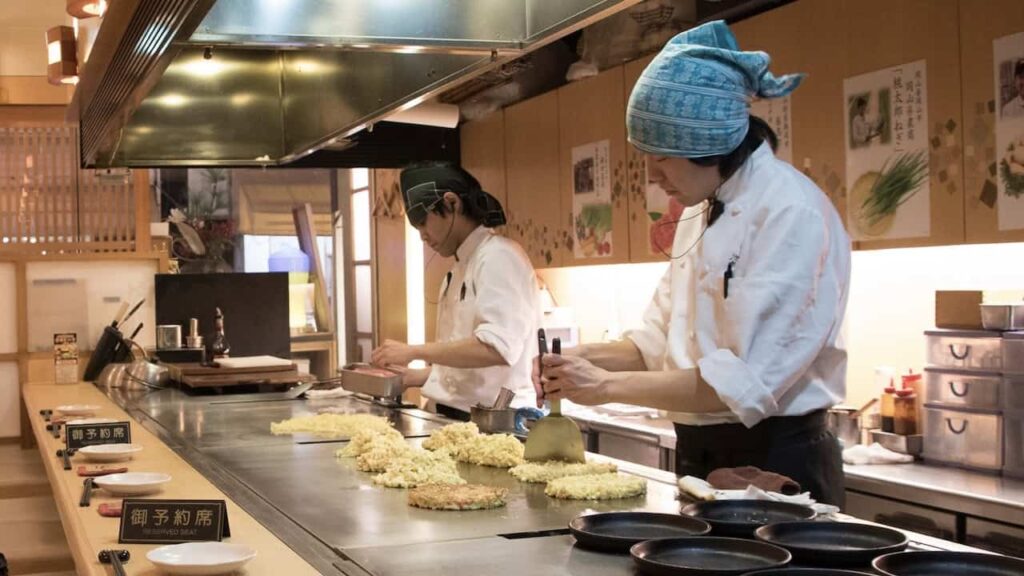
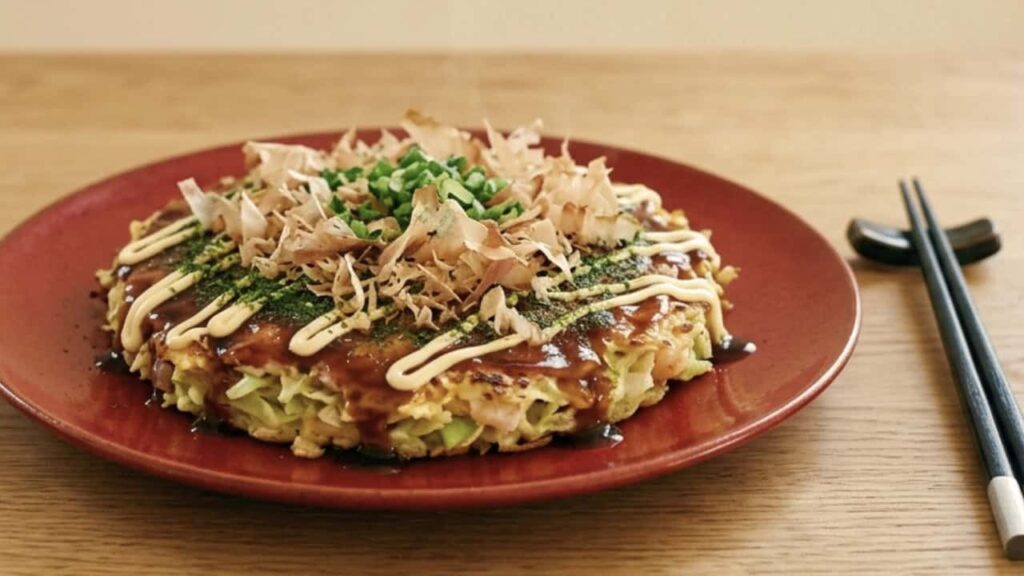
You are intrigued by this dish, so you decide to give it a try. You order one and watch as the chef prepares it for you. First, the chef pours some batter onto the griddle and adds some ingredients. He shapes the mixture into a round cake and flips it over. Then, he adds some sauce, mayonnaise, dried seaweed, and bonito flakes on top. Finally, he cuts it into pieces and serves it to you on a plate. You take a bite and experience a burst of flavors and textures in your mouth. The dish amazes you with how delicious it is. You ask the chef what this dish is called. He smiles and says: “This is Okonomiyaki, the Japanese savory pancake”.
Second, We Have Monjayaki
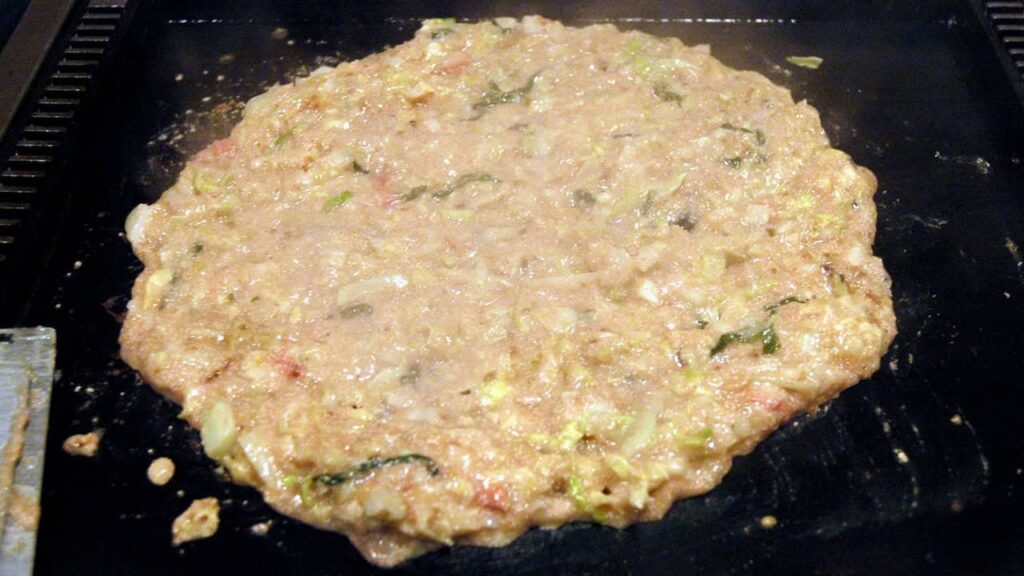
You are satisfied with your meal, but you are also curious about other dishes that Japan has to offer. You walk further down the street and find another iron griddle, where another chef is cooking something that looks similar to Okonomiyaki, but not quite the same. It seems to have a thinner batter and a runnier texture than Okonomiyaki. It looks like a piece of melted cheese or scrambled egg mixture that is spread evenly on the griddle. Yet, it does not have any sauce or toppings on it. You wonder what this dish is and how it tastes.
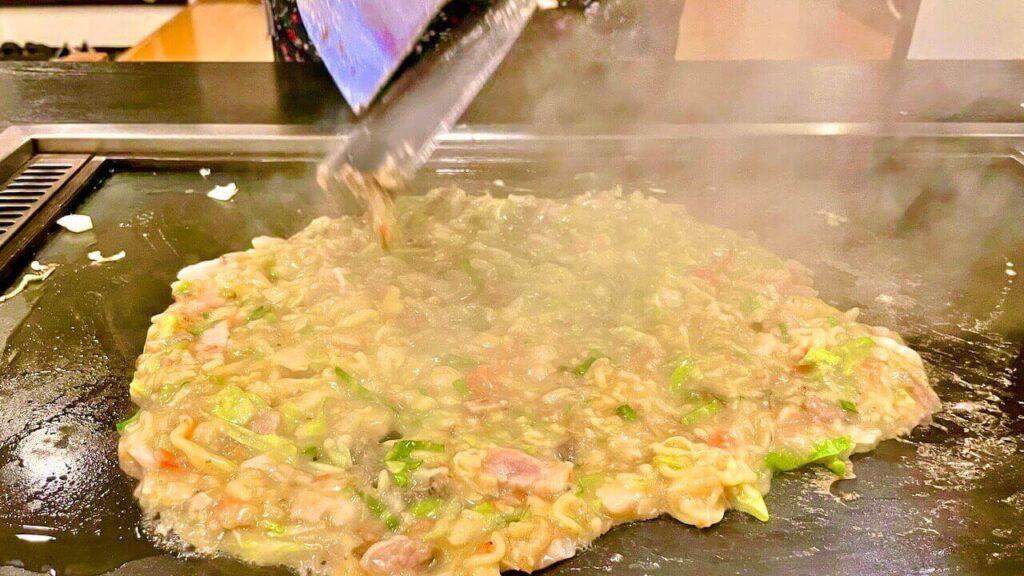
You approach the chef and ask him about this dish. He tells you that this is Monjayaki, another Japanese savory pancake that is popular when visiting Tokyo. He invites you to try it and shows you how to eat it. Next, he gives you a small iron spatula and tells you to scoop up some Monjayaki from the griddle and bring it to your mouth. You do as he says and taste the Monjayaki. Again, this dish surprises you with how soft and moist it is. It has a slightly stronger sauce taste than Okonomiyaki, due to the sauce being mixed into the batter. You find it interesting and unique, but also a bit messy.
Which One is for You?
You thank the chef for his hospitality and continue your journey of exploring Japanese cuisine. You wonder what other dishes Japan has to offer that are similar or different from Okonomiyaki and Monjayaki. Curiously, you want to learn more about these two dishes and how they compare with each other.
If you are like us, you might have been fascinated by these two dishes: Monjayaki vs Okonomiyaki, two of Japan’s most delicious savory pancakes. But what are they exactly? How are they made? How do they taste? And which one is better or more authentic? In this article, we will answer these questions and help you decide which one is the perfect Japanese savory pancake for you.
Read more: Things to Know Before Traveling to Japan
Monjayaki vs Okonomiyaki: What are the Differences?
Monjayaki and Okonomiyaki are both Japanese dishes that are cooked on an iron griddle, called a teppan grill. They both consist of a batter mixed with various ingredients, such as cabbage, meat, seafood, cheese, mochi (rice cake), kimchi (fermented cabbage), noodles, corn, etc. Both have a savory taste that can be enhanced by adding sauce, mayonnaise, dried seaweed (aonori), bonito flakes (katsuobushi), pickled ginger (beni shoga), fried tempura bits (agedama), etc. They can both be eaten as a main dish or a snack, depending on the size and quantity.
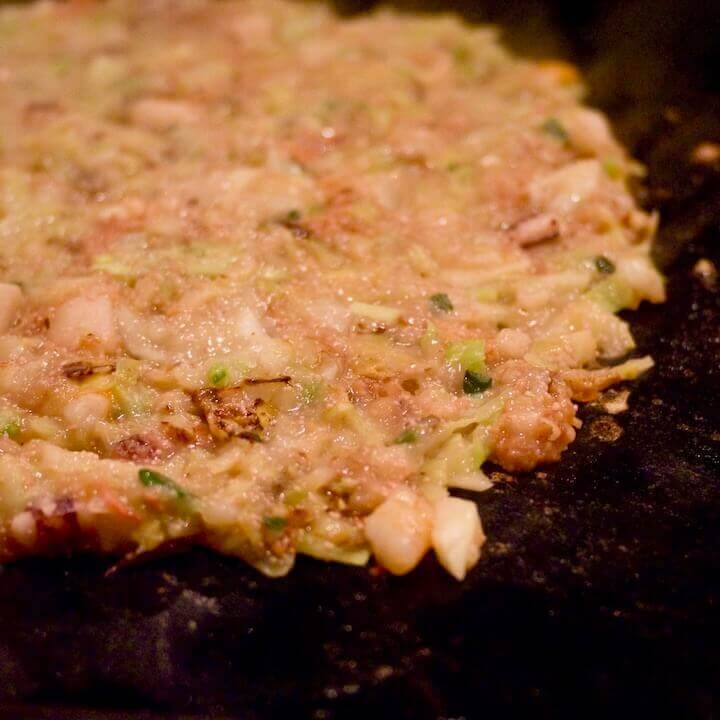
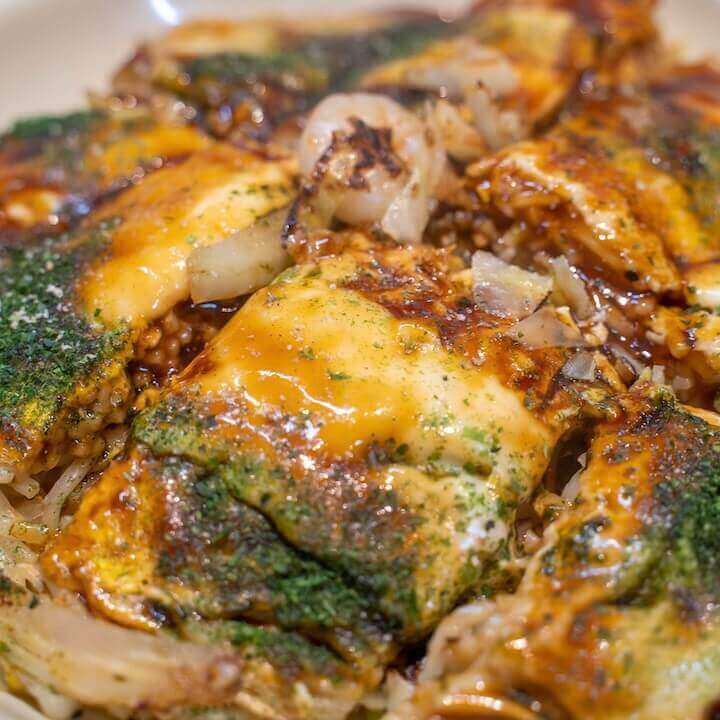
However, Monjayaki and Okonomiyaki also have some differences that make them distinct from each other. These differences include:
| Differences | Monjayaki | Okonomiyaki |
|---|---|---|
| Origins | Tokyo (Kantō region) | Osaka or Hiroshima (Kansai or Hiroshima regions) |
| Batter | Watery and runny | Plain and thick |
| Ingredients | More liquid ingredients, such as dashi stock (a simple broth made from dried kelp and bonito fish flakes) and Worcestershire sauce | More solid ingredients with toppings such as various meats, seafood, noodles, and vegetables |
| Cooking method | Mixing the batter with other ingredients on an iron plate | Molding the mixture into a pancake-like shape |
| Eating style | Eaten directly from the iron plate using small iron spatulas | Cut into pieces and served individually |
These differences affect the texture and flavor of Monjayaki and Okonomiyaki, as well as the way they are enjoyed by the customers.
Then We Have Osaka-Style and Hiroshima-Style Okonomiyaki
Osaka-Style Okonomiyaki
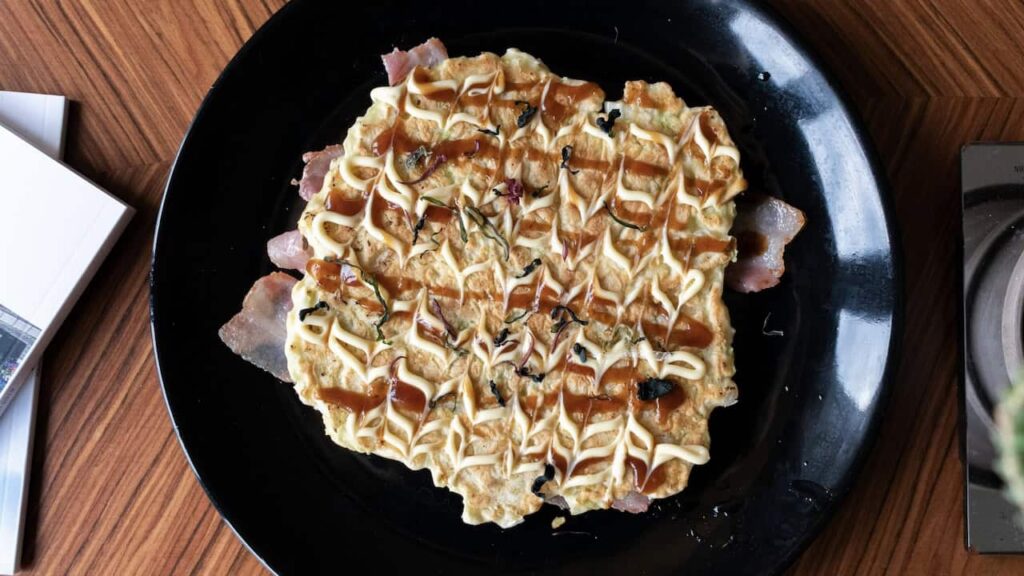
Osaka-style Okonomiyaki is probably the version most people imagine when they hear “Japanese savory pancake.” The batter and ingredients, including shredded cabbage, are mixed together before being poured onto the hot griddle. Meat or seafood can be added to the mixture, and the finished pancake is usually topped with Okonomiyaki sauce, Japanese mayonnaise, aonori, and bonito flakes.
Hiroshima-Style Okonomiyaki
Hiroshima-style Okonomiyaki takes a different approach. Instead of mixing everything together, the ingredients are cooked in layers, with cabbage, meat or seafood, egg, and noodles commonly included. Soba or udon noodles make this version particularly filling, and the finished dish has a distinctive layered texture.
So, if you are traveling around Japan, don’t assume that every Okonomiyaki you try will taste or look the same. Osaka-style, Hiroshima-style, and Tokyo’s Monjayaki offer three very different ways to enjoy Japan’s griddle-cooked food culture.
How are Monjayaki and Okonomiyaki Made?
The process of making Monjayaki and Okonomiyaki is similar, but not exactly the same. Here are the steps for making each dish:
How to Make Monjayaki
- Step 1: Prepare the ingredients.
You will need some finely chopped cabbage, beni shoga, agedama, aonori, squid, shrimp, mentaiko, cheese, or any other ingredients you like. Additionally, you will need some flour, water, dashi stock, Worcestershire sauce, salt, and pepper to make the batter. - Step 2: Make the batter.
In a bowl, mix some flour and water to make a thin paste. Add some dashi stock and Worcestershire sauce to season it. Add some salt and pepper to taste. - Step 3: Cook the Monjayaki.
Heat up an iron griddle over medium-high heat. Add some oil and fry the solid ingredients until slightly browned. Arrange them in a circle shape on the griddle. Pour the liquid batter into the center of the circle. Stir the mixture until it boils and thickens. Break the circle and spread the mixture evenly on the griddle. Cook until slightly crispy on the bottom and gooey on the top.
How to Make Okonomiyaki
- Step 1: Prepare the ingredients.
You will need some sliced cabbage, pork belly, shrimp, squid, octopus, or any other ingredients you like. You will also need some flour, water, eggs, baking powder, salt, and pepper to make the batter. In addition, you will need some Okonomiyaki sauce (a brown sauce similar to Worcestershire sauce), mayonnaise, aonori, katsuobushi, or any other toppings you like. - Step 2: Make the batter.
In a bowl, mix some flour, water, eggs, baking powder, salt, and pepper to make a thick paste. - Step 3: Cook the Okonomiyaki.
Heat up an iron griddle over medium-high heat. Add some oil and pour some batter onto the griddle. Add some ingredients (except raw meat or seafood) on top of the batter. Shape the mixture into a round cake. Place some raw meat or seafood on top of the cake and press lightly. Flip the cake over after a few minutes to cook the other side. Flip again and add some sauce, mayonnaise, aonori, katsuobushi, or any other toppings on top of the cake. Cut into pieces and serve on a plate.
And How Do Monjayaki and Okonomiyaki Taste?
The taste of Monjayaki vs Okonomiyaki depends on the ingredients and toppings used to make them. However, they generally have different textures and flavors that can be described as follows:
Monjayaki
- Texture: Monjayaki has a soft and moist texture that is similar to melted cheese or scrambled eggs. It can be crispy on the bottom and gooey on the top.
- Flavor: Monjayaki has a slightly stronger sauce taste than Okonomiyaki due to the sauce being mixed into the batter. It can be salty, sweet, sour, spicy, or umami (savory) depending on the ingredients.
Okonomiyaki
- Texture: Okonomiyaki has a thicker and firmer texture than Monjayaki, which is similar to a pancake or an omelet. It can be crispy on both sides and soft in the middle.
- Flavor: Okonomiyaki has a milder flavor than Monjayaki, as the sauce is only applied on top of the cake. It can be sweet, sour, spicy, or umami depending on the toppings.
Where to Try Monjayaki and Okonomiyaki in Japan
If you want to experience the difference between these dishes for yourself, Japan offers several excellent destinations.
Try Monjayaki in Tokyo
For Monjayaki, head to Tsukishima Monja Street in Tokyo. This neighborhood is strongly associated with the dish and currently has more than 80 restaurants specializing in Monjayaki. Many restaurants have hot griddles built directly into the tables, allowing diners to enjoy the dish as part of an interactive meal.
This makes Tsukishima one of the best places to experience authentic Tokyo food culture and try different Monjayaki combinations.
Try Okonomiyaki in Osaka
Osaka is one of the best places to experience the classic Kansai-style Okonomiyaki. The dish is widely available throughout the city, from casual specialty restaurants to places where you can cook your own pancake on a griddle built into the table.
If you’re planning a food trip to Japan, adding Okonomiyaki to your Osaka itinerary is an easy way to experience one of the city’s most recognizable comfort foods.
Try Hiroshima-Style Okonomiyaki in Hiroshima
Hiroshima is the place to go if you want to experience the layered version of Okonomiyaki. The city has hundreds of restaurants serving its local style, while Okonomimura is a famous destination where visitors can choose from numerous Okonomiyaki restaurants under one roof.
For the ultimate Japanese food experience, you could even make your own culinary challenge: Monjayaki in Tokyo, Okonomiyaki in Osaka, and Hiroshima-style Okonomiyaki in Hiroshima.
Which One is Better or More Authentic
The question of which one is better or more authentic between Monjayaki and Okonomiyaki is not easy to answer. Actually, it depends on one’s personal preference and taste buds. Some people might prefer Monjayaki for its unique texture and flavor, while others might prefer Okonomiyaki for its substantiality and variety. Besides that, some people might like both dishes equally, or enjoy them on different occasions. The best way to find out which one you like more is to try them yourself.
Popularity and Recognition of the Two Dishes
If we look at the popularity and recognition of these dishes, we might be able to draw some conclusions. Okonomiyaki is more widely known and available than Monjayaki, both in Japan and abroad. Okonomiyaki has also been featured in many anime, manga, movies, and TV shows, such as Naruto, One Piece, Spirited Away, Midnight Diner, etc. Furthermore, Okonomiyaki has been adapted and modified in different countries, such as Korea, Taiwan, Thailand, etc. On top of that, many people around the world consider Okonomiyaki a representative dish of Japanese cuisine. Indeed, it’s one of the 10 Asian dishes that you must try.
Monjayaki, on the other hand, is more of a local specialty of Tokyo that is not as well-known or accessible as Okonomiyaki. Monjayaki is mainly found in the Tsukishima area of Tokyo, where there is a street full of Monjayaki restaurants. Also, Monjayaki has not been featured or mentioned as much as Okonomiyaki in media or culture. Moreover, Monjayaki has not been exported or adapted as much as Okonomiyaki in other countries. Monjayaki is more of a hidden gem of Japanese cuisine for some people who have tried it.
Therefore, Okonomiyaki may be more widely known internationally, but Monjayaki is equally authentic as part of Tokyo’s local food culture. However, this does not mean that Monjayaki is inferior or less authentic than Okonomiyaki. Monjayaki has its own charm and appeal that can attract and satisfy some customers who are looking for something different and unique. Also, Monjayaki is part of Japan’s culinary culture and history that deserves respect and appreciation.
Monjayaki vs Okonomiyaki: Which One Should You Try?
Still can’t decide between Monjayaki vs Okonomiyaki? Your choice may come down to what kind of food experience you prefer.
Choose Monjayaki if you:
- Want to try a unique Tokyo specialty
- Enjoy soft and gooey textures
- Like interactive dining
- Want to try something less familiar
- Are curious about local Tokyo food culture
Choose Okonomiyaki if you:
- Prefer a thicker, more substantial meal
- Like crispy edges and a fluffy center
- Are trying Japanese savory pancakes for the first time
- Enjoy different meat, seafood, and vegetable combinations
- Want to explore regional Japanese cuisine
But honestly, why choose only one?
If your Japan itinerary allows it, try Monjayaki in Tokyo and Okonomiyaki in Osaka or Hiroshima. Comparing them in their home regions is one of the best ways to appreciate how diverse Japanese cuisine can be.
And remember, there isn’t a single “better” or “more authentic” winner. Monjayaki and Okonomiyaki are both authentic Japanese dishes, each with its own regional identity, cooking style, and loyal fans.
FAQs About Monjayaki vs Okonomiyaki
What Is the Main Difference Between Monjayaki and Okonomiyaki?
The main difference is texture and batter. Monjayaki uses a much thinner, dashi-rich batter that stays soft and gooey, while Okonomiyaki has a thicker batter that cooks into a firmer, pancake-like dish. Monjayaki is especially associated with Tokyo, while Okonomiyaki is strongly connected with Osaka and Hiroshima.
What to Eat With Okonomiyaki?
Okonomiyaki is usually served with Okonomiyaki sauce, Japanese mayonnaise, aonori (dried seaweed), and katsuobushi (bonito flakes). You can also enjoy it with pickled ginger, a simple salad, edamame, or a bowl of miso soup for a more complete Japanese meal.
How Unhealthy Is Okonomiyaki?
Okonomiyaki can be a fairly filling meal, but it isn’t necessarily unhealthy. Its nutritional value depends on the batter, toppings, portion size, and amount of sauce and mayonnaise used. Cabbage provides vegetables and fiber, while seafood or lean meat can add protein, but generous amounts of sauce, mayonnaise, cheese, or fatty pork can increase calories, fat, and sodium.
How to Eat Monjayaki and Okonomiyaki?
Okonomiyaki is usually cut into small pieces and eaten with chopsticks or a small spatula, while Monjayaki is traditionally eaten directly from the hot griddle using a small metal spatula. For Monjayaki, scrape a small portion from the griddle, allowing the crispy bits to mix with the soft center, and enjoy it while hot.
Why Is Okonomiyaki So Important in Japan?
Okonomiyaki is important because it is an affordable, customizable dish deeply connected to Japanese regional food culture, particularly Osaka and Hiroshima. Its casual preparation, wide variety of ingredients, and social style of cooking on a griddle have made it a beloved comfort food in Japan and a popular introduction to Japanese cuisine for travelers.
We hope this article has helped you learn more about Monjayaki vs Okonomiyaki, two of Japan’s most delicious savory pancakes. Have you tried them before? Which one do you like more? Let us know in the comments below!
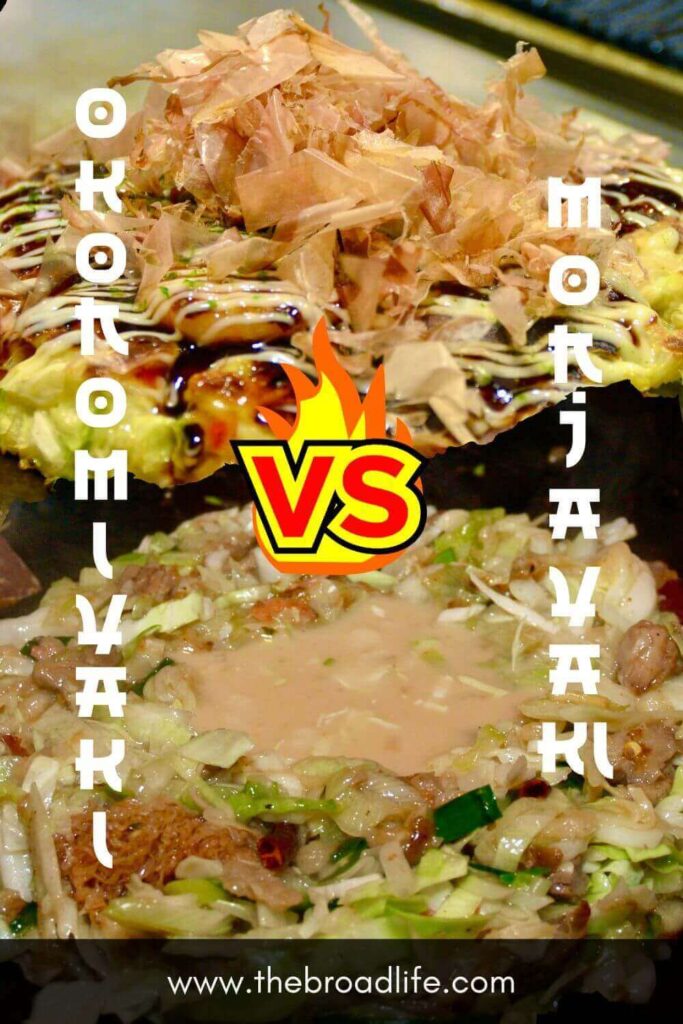
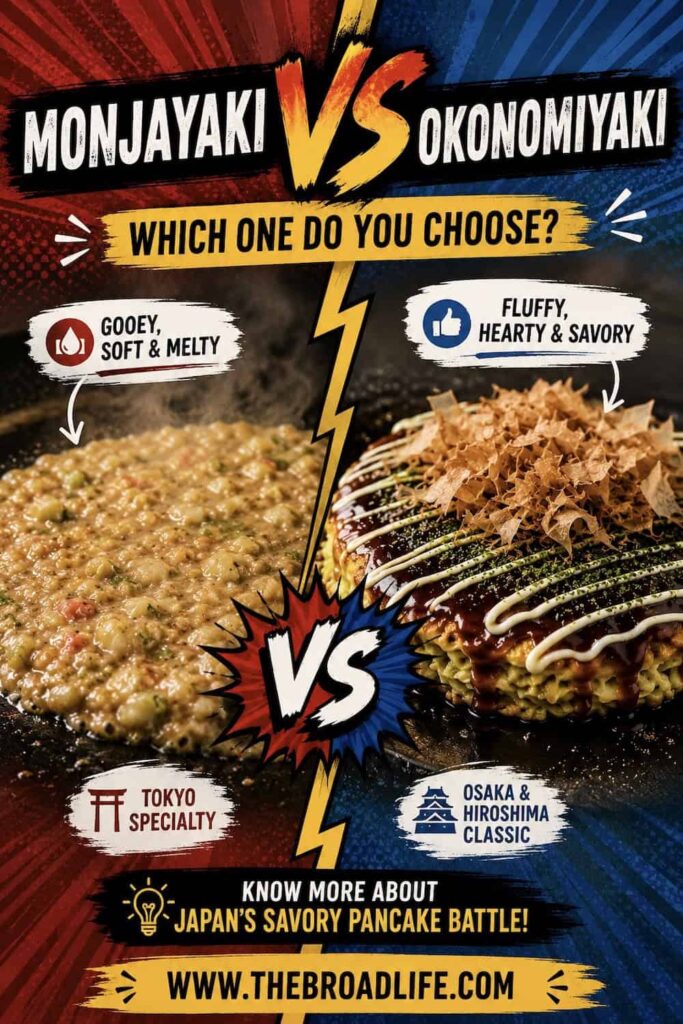
IF YOU LIKE THE INFO ABOUT MONJAYAKI VS OKONOMIYAKI IN THIS POST, ‘PIN IT’ NOW!

Khoi Nguyen
Khoi Nguyen builds The Broad Life with a desire to inspire people go exploring the world and live a more interesting, experience, and adventurous life. This blog shares the stories, pictures, and experiences at destinations where he has traveled to.



Leave a Reply