Top 10 Longest Sea Bridges in the World
The longest sea bridges in the world are remarkable examples of modern engineering, connecting cities, countries, and communities across bays, straits, and coastal waters. Beyond improving transportation and supporting trade, these impressive structures often become famous landmarks that attract travelers interested in architecture, engineering, and spectacular views.
Bridges have always played an important role in human development. Today, their significance extends beyond traffic and the economy, as many feature unique designs that inspire millions of tourists every year. From China’s Hong Kong–Zhuhai–Macao Bridge to the King Fahd Causeway linking Saudi Arabia and Bahrain, let’s follow The Broad Life to explore 10 of the world’s longest sea bridges and major water crossings!
Quick Comparison of the 10 Longest Sea Bridges and Water Crossings
| Bridge or crossing | Location | Length | Completion date | Notable feature |
|---|---|---|---|---|
| Mackinac Bridge | Michigan, USA | About 8 km | 1957 | Connects Michigan’s Upper and Lower Peninsulas |
| Øresund Bridge | Denmark and Sweden | 7.845 km for the bridge structure, 15.9 km for the complete link | 2000 | Bridge, artificial island, and tunnel |
| Seven Mile Bridge | Florida, USA | About 10.9 km | 1982 | Famous Florida Keys road-trip landmark |
| San Francisco–Oakland Bay Bridge | California, USA | About 13.4 km | 1936 | Major San Francisco Bay crossing |
| Vasco da Gama Bridge | Lisbon, Portugal | About 17.2 km | 1998 | Crosses the Tagus River estuary |
| King Fahd Causeway | Saudi Arabia and Bahrain | About 25 km | 1986 | Connects two countries |
| Donghai Bridge | Shanghai, China | About 32.5 km | 2005 | Connects Shanghai with Yangshan Port |
| Lake Pontchartrain Causeway | Louisiana, USA | 38.422 km for the longer bridge | 1969 | Longest continuous bridge over water |
| Jiaozhou Bay Bridge | Qingdao, China | About 41.58 km | 2011 | Major bay crossing |
| Hong Kong–Zhuhai–Macao Bridge | China | 55 km total project length | 2018 | Bridge-and-tunnel sea crossing |
Quick note: The measurements above are useful for comparing these engineering landmarks, but they do not all represent the same type of length. In particular, the Hong Kong–Zhuhai–Macao Bridge figure includes connecting roads, and the Øresund crossing includes a bridge, an artificial island, and a tunnel. The Lake Pontchartrain Causeway crosses a lake rather than the sea, while the Mackinac Bridge crosses a strait between the Great Lakes.
The 10 Longest Sea Bridges and Major Water Crossings in the World
These impressive bridges and water crossings demonstrate the scale of modern infrastructure around the world. The list includes their reported lengths, locations, and notable features, while distinguishing complete crossings from individual bridge structures where necessary.
10. Mackinac Bridge – Michigan, USA
- Length: About 8.03 km
- Completion year: 1957

One of the most famous and historically significant bridges in America, the Mackinac Bridge spans approximately 8 kilometers. This is the third-longest suspension bridge in the United States and the second-longest suspension span in North America, according to the original article’s description. The bridge is not only a freight route but also a place that attracts tourists and photographers from all over the world.
The Mackinac Bridge crosses the Straits of Mackinac, connecting Michigan’s Upper and Lower Peninsulas between Lake Michigan and Lake Huron. Although it is sometimes included in broad lists of long water crossings, it is not technically a sea bridge.
For travelers exploring Michigan, the bridge is an iconic part of the Great Lakes experience. Its long suspension span and surrounding waters create memorable views, particularly from designated viewpoints around the region. Visitors should check weather and road conditions before traveling, as conditions around the Great Lakes can change quickly.
9. Øresund Bridge – Copenhagen, Denmark and Malmö, Sweden
- Length: 7.845 km for the bridge structure, approximately 15.9 km for the complete link
- Completion year: 2000

Located across the Øresund Strait between Denmark and Sweden, the Øresund connection is a unique combination of bridge, artificial island, and underwater tunnel. Viewed from above, the bridge appears to end in the middle of the water, with the rest of the crossing continuing through the island and tunnel.
Designed by George K.S. Rotne, the bridge structure itself is approximately 7.845 kilometers long. The complete connection measures about 15.9 kilometers, including Peberholm, an artificial island, and a 4.05-kilometer tunnel. The bridge’s design allows road and rail transport to cross the strait while accommodating the surrounding maritime environment.
The Øresund connection is more than an engineering achievement. It makes travel between Copenhagen and Malmö easier, allowing visitors to experience two countries in one trip. Travelers can explore Danish architecture, museums, and food before continuing to Sweden for its design culture, waterfront areas, and urban attractions.
8. Seven Mile Bridge – Florida, USA
- Length: About 10.88 km
- Completion year: 1982 for the modern bridge

The Seven Mile Bridge is an iconic bridge in Florida, forming part of the Overseas Highway through the Florida Keys. It crosses open water between the Middle Keys and the Lower Keys, making it a memorable part of the drive through this island chain. With its long roadway and stunning ocean views, the Seven Mile Bridge is not only one of the longest bridges in the United States, but also a fascinating sight.
The bridge is particularly appealing to travelers who enjoy scenic road trips, coastal landscapes, and photography. Its long stretch over the water creates the feeling of driving across the sea, with views of the surrounding blue waters and islands. If you’re planning a Florida Keys road trip, allow time to explore nearby destinations and designated viewpoints. Do not stop or park on the bridge except where permitted.
7. San Francisco – Oakland Bay Bridge – Oakland, USA
- Length: About 13.4 km
- Opening year: 1936

Inaugurated in 1936, the San Francisco–Oakland Bay Bridge spans more than 13.4 kilometers, connecting San Francisco and Oakland across San Francisco Bay. It remains an essential transportation route for the Bay Area and a major example of American bridge engineering.
The original article describes the bridge’s highest tower shaft as approximately 160 meters high, with lights illuminating the structure at night. The Bay Bridge is a complex crossing with multiple sections rather than a single simple span. Its design and scale reflect the challenges of building a major road connection across a busy bay.
For visitors to San Francisco, the bridge is part of the wider waterfront landscape. Travelers can enjoy views of the bridge and bay from suitable public viewpoints, then explore other nearby attractions, including the city’s waterfront districts and famous landmarks.
6. Vasco Da Gama Bridge – Lisboa, Portugal
- Length: About 17.2 km
- Opening year: 1998

Named after the famous Portuguese explorer Vasco da Gama, this bridge is one of Europe’s most impressive modern transportation structures. Located in Lisbon, Portugal, it crosses the Tagus River estuary and provides an important road connection around the capital.
The original article reports that the project cost approximately US$1 billion and describes the bridge as an important traffic route connecting the northern and southern parts of Portugal.
The bridge and its associated crossing extend approximately 17.2 kilometers. It opened in 1998 and was built to improve traffic flow around Lisbon. Because it crosses a river estuary rather than open sea, it is more accurately described as a major water crossing than a sea bridge.
Lisbon is an excellent destination for travelers interested in architecture, history, food, and riverfront scenery. You can explore the city’s historic neighborhoods, viewpoints, and Portuguese landmarks while appreciating how the Vasco da Gama Bridge supports regional transportation.
5. King Fahd Causeway – Khobar, Saudi Arabia and Al Jasra, Bahrain
- Length: About 25 km
- Opening year: 1986

The King Fahd Causeway connects Saudi Arabia with the island nation of Bahrain. Built to promote trade and strengthen connections between the two countries, this major causeway is one of the most important transportation links in the Gulf region.
The original article reports that the project cost approximately US$1.2 billion, opened to the public in 1986, and stretches about 25 kilometers with four traffic lanes. It also reports an average of more than 45,000 vehicles passing through daily.
The causeway’s length is commonly reported at approximately 25 kilometers. Its importance extends beyond transportation, supporting cross-border journeys, commerce, and connections between communities in Saudi Arabia and Bahrain.
For travelers planning to drive between the two countries, check current border-entry requirements, vehicle regulations, toll information, and travel advisories before setting out. The causeway is an important route for both business and leisure travel.
4. Donghai Bridge – Zhoushan, China
- Length: About 32.5 km
- Construction began: June 26, 2002
- Completion year: 2005

Completed in 2005, the Donghai Bridge was one of China’s earliest major sea-crossing bridges. Stretching approximately 32.5 kilometers across coastal waters, it connects Shanghai with Yangshan Deep-Water Port and supports the movement of goods through one of the world’s important port regions. The bridge has six traffic lanes and plays a significant role in China’s land-sea trade.
The Donghai Bridge demonstrates how large-scale bridge engineering can support port operations and international commerce. Its long route across coastal waters was designed to improve access to the offshore port, helping connect maritime shipping with the mainland transportation network.
Although Donghai Bridge is primarily an infrastructure route rather than a conventional tourist attraction, it is an interesting example for readers fascinated by modern engineering, global trade, and China’s coastal development.
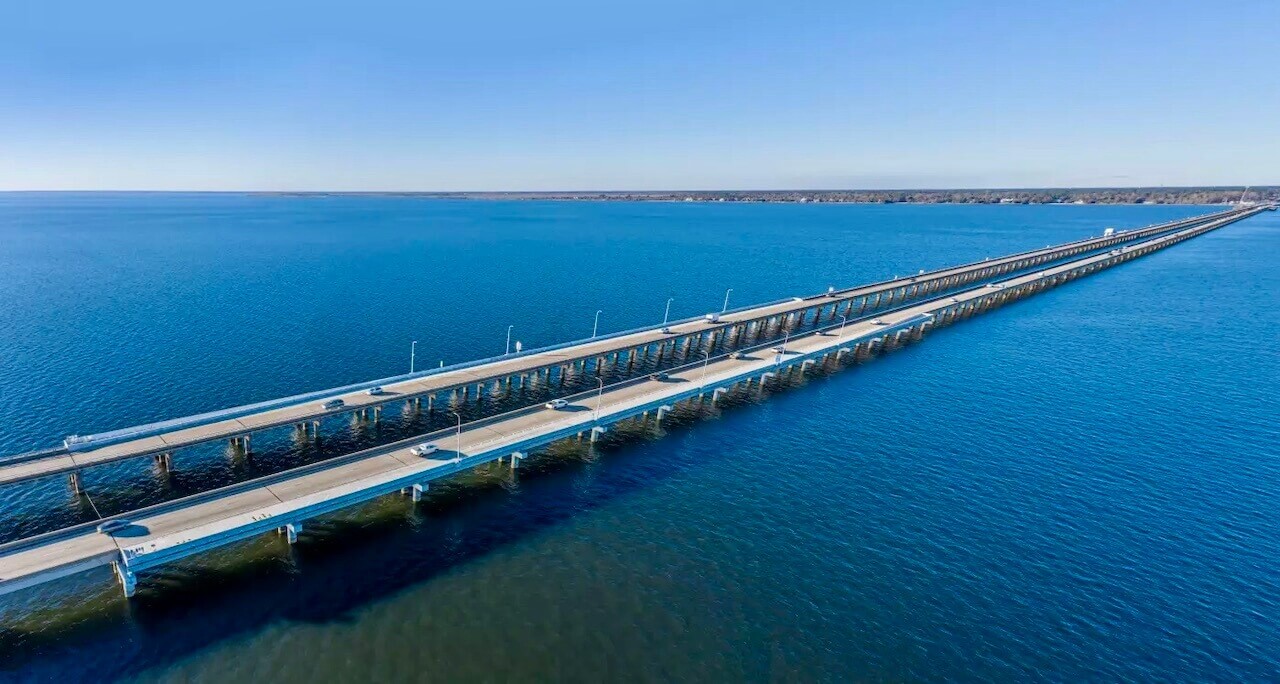
3. Lake Pontchartrain Causeway – Louisiana, USA
- Length: About 38.44 km, commonly reported as 38.422 km for the longer bridge
- Completion year: 1969

The Lake Pontchartrain Causeway is a famous bridge in Louisiana, United States, spanning Lake Pontchartrain and connecting Metairie, near New Orleans, with Mandeville on the northern shore.
The causeway consists of two parallel bridges. The longer bridge measures approximately 38.422 kilometers and is recognized by Guinness World Records as the longest continuous bridge over water.
In addition to facilitating transportation across the lake, the causeway has become a notable feature of Louisiana’s road network. Its great length means drivers spend a considerable time crossing open water, with the lake extending across the horizon.
The causeway is an impressive example of a long, continuous water crossing, although it is important to clarify that Lake Pontchartrain is a lake rather than the sea. Travelers visiting the New Orleans region may encounter the causeway when exploring destinations around the lake.
2. Jiaozhou Bay Bridge – Qingdao, China
- Length: About 41.58 km, as reported in the original article
- Completion year: 2011

With a length of approximately 41.58 kilometers and six lanes, the Jiaozhou Bay Bridge in Qingdao, China, is one of the world’s most impressive large-scale bridge projects. The original article states that it was recognized by Guinness in 2012 as the longest sea-crossing bridge in the world by total length.
The bridge crosses Jiaozhou Bay and connects areas of Qingdao, helping shorten road journeys around the bay. Its construction is widely reported to have used approximately 450,000 tonnes of steel and 2.3 million cubic meters of concrete. Published engineering summaries also describe 5,238 concrete piles supporting the structure, rather than the rounded figure of 5,200 used in the original article.
The original article also states that the bridge can withstand magnitude 8 earthquakes. This is an important engineering claim, but the exact design specification should be confirmed against a primary engineering source before presenting it as a definitive guarantee.
The Jiaozhou Bay Bridge is designed to cope with challenging marine conditions. Published descriptions of the project also mention resistance to severe earthquakes, typhoons, and ship collisions. These capabilities reflect the demands of building a long bridge across a busy bay exposed to changing weather and maritime traffic.
The bridge’s impressive length, steel quantity, concrete foundations, and six-lane roadway make it a striking example of modern Chinese infrastructure. For readers interested in engineering, it demonstrates how extensive support systems and durable materials are essential when building long bridges over water.
1. Hong Kong–Zhuhai–Macau Bridge (China)
- Length: About 55 km for the complete project
- Opening year: 2018

After opening in 2018, the Hong Kong–Zhuhai–Macao Bridge (HZMB) became one of the world’s most remarkable sea-crossing infrastructure projects. Stretching approximately 55 kilometers in total, it is recognized as the world’s longest bridge-cum-tunnel sea crossing. Moreover, it connects Hong Kong, Zhuhai, and Macao across China’s Pearl River Delta, improving regional connectivity.
The project consists of three main sections: the 12-kilometer Hong Kong Link Road, the 29.6-kilometer Main Bridge, and the 13.4-kilometer Zhuhai Link Road. In addition, the main bridge incorporates a 6.7-kilometer immersed tunnel and two artificial islands, each covering approximately 100,000 square meters. As a result, large ships can continue using important navigation routes without disrupting maritime traffic.
Equally impressive are the bridge’s reported engineering specifications. According to project-related engineering sources, the HZMB was designed to withstand a magnitude-8 earthquake, a level-16 typhoon, and the impact of a 300,000-ton vessel. However, these figures describe design capabilities, rather than guarantees against every possible extreme event.
Construction also required enormous quantities of materials. The original article reports approximately 1.08 million cubic meters of cement and 400,000 tonnes of steel. While engineering literature supports the figure of roughly 400,000 tonnes of steel, the cement estimate should be verified against its original source. Similarly, comparisons with the materials used for the Golden Gate Bridge or enough steel to build 60 Eiffel Towers should be retained only if their underlying figures and material categories can be confirmed.
Overall, the HZMB showcases how modern engineering combines bridges, tunnels, and artificial islands into one transportation system. Beyond its impressive scale, it strengthens connections between major cities in the Pearl River Delta while addressing the challenges of seismic activity, powerful winds, maritime navigation, and construction in a marine environment.
Extra: Golden Gate Bridge – California, USA
- Length: About 2.7 km
- Opening year: 1937

The Golden Gate Bridge is one of the most recognizable bridges in the world. Located in San Francisco, California, it crosses the Golden Gate strait and connects San Francisco with Marin County.
The original article describes the bridge as a steel structure weighing more than 80,000 tons. Because the precise meaning of that figure may refer to a particular component or material category, verify the original source before publishing it as the weight of the entire bridge.
Although it is much shorter than the other crossings in this article, the Golden Gate Bridge is celebrated for its distinctive International Orange color, suspension design, and spectacular setting between the Pacific Ocean and San Francisco Bay.
It is a must-see landmark for many travelers visiting San Francisco. Visitors can admire the bridge from designated viewpoints, explore nearby parks, and photograph the structure from different angles. The Golden Gate Bridge may not rank among the longest bridges by total length, but its architectural significance and travel appeal make it a worthy bonus entry.
If you enjoy bridges for their design and architecture as well as their size, explore The Broad Life’s guide to 8 Ornate Bridges in the World.
How Are the World’s Longest Sea Bridges Measured?
The term longest sea bridges can refer to different measurements. Understanding these categories helps explain why rankings vary between sources.
Total project length
Total project length includes the bridge and its connecting roads or other sections that form part of the overall transportation project. The Hong Kong–Zhuhai–Macao Bridge is a clear example, with a total project length of approximately 55 kilometers.
Bridge structure length
Bridge structure length measures the bridge itself, rather than the full transportation connection. The Øresund Bridge is approximately 7.845 kilometers long as a bridge structure, while the complete link, including an artificial island and tunnel, measures about 15.9 kilometers.
Continuous length over water
This category focuses on the length of a bridge that continuously crosses water. The Lake Pontchartrain Causeway is recognized by Guinness World Records in this category, with its longer bridge measuring approximately 38.422 kilometers.
Sea bridges versus other water crossings
Not every long bridge over water is technically a sea bridge. Some cross lakes, rivers, estuaries, or straits between inland bodies of water. For example, the Lake Pontchartrain Causeway crosses a lake, the Vasco da Gama Bridge crosses a river estuary, and the Mackinac Bridge crosses the Straits of Mackinac between the Great Lakes.
Including these structures in a broader list of long water crossings is useful, provided the article clearly explains the geographical differences.
FAQs About the Longest Sea Bridges
What is the longest water bridge in the world?
The Hong Kong–Zhuhai–Macao Bridge (HZMB) is the world’s longest bridge-cum-tunnel sea crossing. Located in China’s Pearl River Delta, the entire project stretches approximately 55 kilometers (34 miles), including connecting roads, the main bridge, and an underwater tunnel. According to Guinness World Records, its aggregate bridge length over water is 48.3 kilometers. However, the Lake Pontchartrain Causeway in Louisiana, USA, holds the record for the longest continuous bridge over water, at 38.422 kilometers.
What are the top 10 largest bridges in the world?
Rankings vary depending on whether total length, main span, or distance over water is measured. By overall length, some of the world’s longest bridges and viaducts include:
- Danyang–Kunshan Grand Bridge, China
- Changhua–Kaohsiung Viaduct, Taiwan
- Kita-Yaita Viaduct, Japan
- Tianjin Grand Bridge, China
- Cangde Grand Bridge, China
- Weinan Weihe Grand Bridge, China
- Bang Na Expressway, Thailand
- Hong Kong–Zhuhai–Macao Bridge, China
- Beijing Grand Bridge, China
- Lake Pontchartrain Causeway, USA
These structures serve different purposes, from high-speed rail to road transport and sea crossings. Therefore, this is a general overview rather than a definitive ranking of bridges by every measurement method.
What are the top 5 bridges in the world?
There is no universally accepted top-five ranking because bridges can be judged by length, engineering achievements, design, or historical significance. Nevertheless, five outstanding examples are the Danyang–Kunshan Grand Bridge in China for its record-breaking length, the Hong Kong–Zhuhai–Macao Bridge for its bridge-and-tunnel engineering, the Akashi Kaikyo Bridge in Japan for its enormous suspension span, the Millau Viaduct in France for its dramatic design, and the Golden Gate Bridge in the USA for its iconic appearance.
Each stands out for a different reason, making these bridges remarkable destinations for architecture and engineering enthusiasts.
What are the 10 most beautiful bridges in the world?
Beauty is subjective, but these ten bridges are celebrated for their distinctive architecture, scenery, or historical character:
- Golden Gate Bridge, USA
- Tower Bridge, England
- Brooklyn Bridge, USA
- Charles Bridge, Czech Republic
- Stari Most, Bosnia and Herzegovina
- Sydney Harbour Bridge, Australia
- Øresund Bridge, Denmark and Sweden
- Helix Bridge, Singapore
- Ponte Vecchio, Italy
- Golden Bridge, Vietnam
From historic stone crossings to modern engineering landmarks, each offers a unique experience for travelers and photographers.
Where is Asia’s longest bridge?
Asia’s longest bridge is the Danyang–Kunshan Grand Bridge, located in China’s Jiangsu Province. Measuring approximately 164.8 kilometers (102.4 miles), it forms part of the Beijing–Shanghai High-Speed Railway and holds the record as the world’s longest bridge overall. However, if you mean the longest bridge-cum-tunnel sea crossing, that distinction belongs to the Hong Kong–Zhuhai–Macao Bridge, also in China.
What is the most visited bridge in the world?
There is no widely recognized, authoritative global ranking that conclusively identifies the world’s most visited bridge. However, the Brooklyn Bridge in New York City is one of the world’s best-known and most popular bridges for sightseeing, walking, and photography. Similarly, San Francisco’s Golden Gate Bridge attracts visitors with its iconic design and spectacular bay views. Both are must-see landmarks for travelers exploring the United States.
Conclusion
The world’s longest sea bridges and major water crossings demonstrate how engineering connects communities, improves transportation, and supports regional development. From the 55-kilometer Hong Kong–Zhuhai–Macao Bridge to the scenic Seven Mile Bridge in Florida, each structure has its own history, construction challenges, and place in the surrounding landscape.
Some bridges stand out for their enormous quantities of steel and concrete, while others are notable for their ability to accommodate challenging marine conditions, their international connections, or their role in memorable road trips. Whether you’re interested in bridge engineering, famous landmarks, or travel destinations with spectacular views, these structures offer plenty to discover.
Remember that a bridge’s reported length may include connecting roads, tunnels, or artificial islands, so the longest bridge by total project length is not necessarily the longest continuous bridge over water.
Craving more wanderlust? The Broad Life unveils epic travel books to fuel your next adventure. These aren’t just guides—they’re tales of authors exploring new worlds, uncovering hidden gems, and soaking up wild cultures. Dive into the best travel reads now!
> READ MORE: THE BEST TRAVEL BOOKS OF ALL TIME
‘PIN IT’ NOW TO SAVE YOUR LIST OF THE TOP 10 LONGEST SEA BRIDGES IN THE WORLD